



Ranked review of AI-driven inventory optimization platforms for asset-heavy teams, with a deep focus on ARIVA.
Why AI inventory platforms matter for asset-heavy MRO teams
For asset‑heavy enterprises, AI‑driven inventory optimization promises a compelling trade-off: lower inventory carrying costs without compromising uptime or safety. Yet most of the noise in the AI tools for inventory market is aimed at retail, e‑commerce, and fast‑moving distribution, not at complex MRO and capital spares. Supply chain and maintenance leaders in industries like oil and gas, chemicals, utilities, and heavy manufacturing need platforms that can deal with low‑turn, safety‑critical parts spread across storerooms, yards, and remote sites—and they need those platforms to connect cleanly with existing ERPs, EAM systems, and reliability programs.
Before comparing specific platforms, it is worth clarifying what “AI‑driven inventory optimization” really means. At its core, it involves using machine learning and advanced analytics to align stocking decisions with actual risk and demand patterns, rather than relying on static min/max settings or rules of thumb. That includes powering better demand forecasting (especially for intermittent demand), dynamically adjusting safety stocks, identifying duplicates and obsolete items, and surfacing where capital is trapped in low‑value or redundant inventory. The goal is to improve service levels and supply chain efficiency while simultaneously taking cash out of the network.
However, in MRO environments there is a precondition that general-purpose AI tools often gloss over: if your physical counts and master data are wrong, even the smartest optimization engine will recommend the wrong actions. Ghost inventory, missing or inconsistent manufacturer data, and poorly structured item masters will all push algorithms toward false conclusions. This is precisely why ALLSERV built ARIVA—not as another planning module, but as an inventory intelligence layer grounded in field‑verified counts and high‑fidelity data.
ARIVA focuses on three jobs that asset‑heavy teams struggle to tackle with generic systems. First, it connects physical reality to digital records by combining professional, standardized inventory counts with robust data capture methods. Second, it uses AI and domain expertise to standardize and enrich item masters, normalizing manufacturers, part numbers, and attributes so spare parts can be identified and compared reliably. Third, it builds a living knowledge graph that shows how parts, equipment, and suppliers are related across plants, highlighting duplicates, substitutions, and obsolescence risk.
For supply chain and inventory leaders, this foundation is what turns AI‑driven inventory optimization from a buzzword into a practical strategy. When ARIVA is paired with robust governance and ALLSERV’s broader MRO data services, it becomes the backbone of an AI inventory roadmap: a way to safely reduce inventory carrying costs, improve demand forecasting precision, and enhance supply chain efficiency in some of the most complex operating environments in the world.
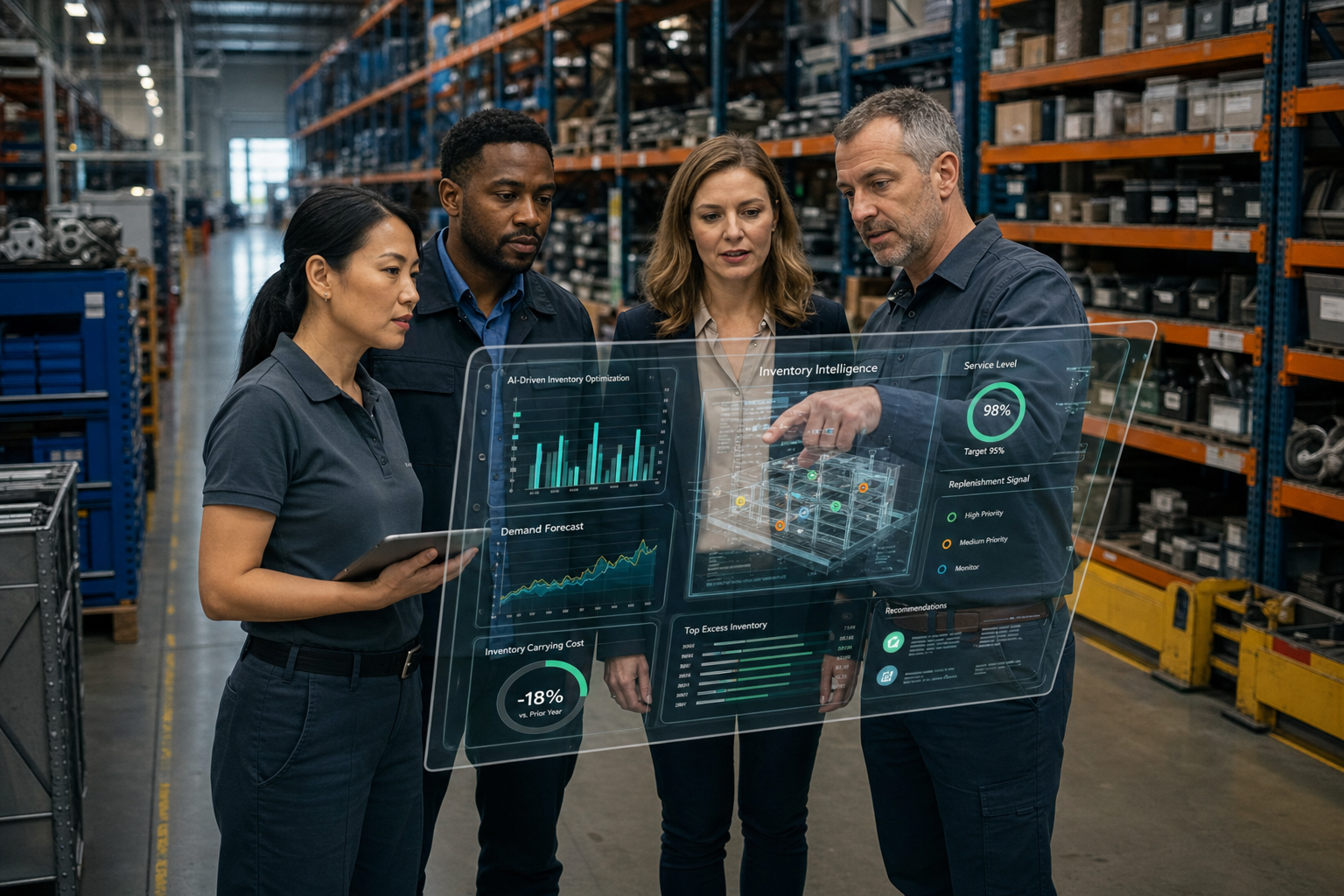 Ranked review of top AI inventory optimization platforms
While ARIVA is purpose-built for asset‑intensive MRO environments, most leadership teams want to understand how it compares to broader AI inventory optimization platforms. Several categories of solutions dominate the landscape: end-to-end AI supply chain suites, specialized demand forecasting engines, and inventory optimization add-ons from ERP or planning vendors. Each can play a role—but their fit for complex, low‑turn MRO and capital spares is very different from fast‑moving finished goods.
At the enterprise AI suite end of the spectrum, platforms like C3 AI Demand Planning focus on high‑volume SKU networks in consumer, industrial, and distribution environments. Their strengths lie in ingesting massive data sets across sales, marketing, and operations to generate highly accurate forecasts and consensus demand plans. For example, C3 AI highlights how its demand planning product combines a digital twin with advanced ML models to deliver 92%+ forecast accuracy and 10%+ inventory reductions in traditional supply chains, as outlined on the C3 AI Demand Planning page at C3 AI Demand Planning. These capabilities are powerful for finished goods and distribution center inventory, but they generally assume relatively clean item masters and high historical demand signal quality—conditions that are rarely true in MRO.
Another class of tools focuses on AI-powered demand sensing and risk signals. Solutions such as SupplyChainStack’s AI demand forecasting product use real-time tariff, freight, and supplier disruption signals to build short‑term forecasts in seconds, aimed at planners who need to respond to volatility in customer demand or inbound supply. Their quick-brief interface and multi-stream data ingestion, described at SupplyChainStack AI demand forecasting software, can help materials teams tune replenishment for repeatable demand patterns. However, they still sit on top of whatever inventory and master data they receive from upstream systems—meaning that if spare parts data is fragmented, their recommendations may be misapplied.
There are also AI-native supply chain orchestration platforms like Sigmoid’s Supply Chain Intelligence Suite, which unifies planning, risk modeling, and network optimization in a single environment. Sigmoid emphasizes 10% reductions in supply chain cost and 40% improvements in on-time delivery through agentic AI-driven orchestration, as highlighted on the Supply Chain Suite overview at Sigmoid Supply Chain Intelligence Suite. These platforms are compelling for organizations looking to harmonize demand, supply, and logistics decisions, especially in more standardized product flows. But again, their value in MRO environments is constrained by the quality of underlying item masters and physical inventory accuracy.
Within the retail and manufacturing domain, unified AI platforms like AIVOX offer capabilities that span inventory, pricing, merchandising, and production. AIVOX, as described on its product site at AIVOX AI-native inventory and pricing platform, leverages built-in ML to optimize inventory and availability across channels while improving sustainability and margin. For asset‑heavy enterprises that also have large retail or aftermarket operations, these platforms can be valuable on the finished-goods side of the house, but they rarely address the messy, technical world of spare parts in depth.
This is where ARIVA stands out. Instead of assuming that ERP and planning data is already clean and complete, ARIVA starts with the hard work of reconciling physical reality with unreliable systems of record. It integrates ALLSERV’s on-site MRO inventory counts with AI enrichment and a proprietary knowledge graph that normalizes manufacturers, part numbers, and equivalencies across plants. That means AI insights are grounded in the truth of what is actually on shelves and how parts are used on real assets. For MRO leaders, this is the critical difference between generic AI recommendations and inventory intelligence they can act on with confidence.
How to select and roll out AI inventory tools
Selecting and rolling out AI inventory optimization tools in asset‑intensive environments requires a different playbook than in high‑volume retail or distribution. The stakes are higher—stockouts can shut down a refinery unit or offshore rig—and the data landscape is more chaotic, with decades of inconsistent part records, local workarounds, and overlapping systems. To succeed, supply chain and maintenance leaders should evaluate platforms through three lenses: data readiness and cleansing, MRO‑specific intelligence, and adoption in the field.
First, test how each platform deals with dirty, incomplete, and fragmented MRO data. Ask vendors to demonstrate not just fancy dashboards, but how they will reconcile duplicate material numbers, normalize manufacturer information, and tie parts back to actual equipment. Generic AI tools often assume that item masters are already well structured, which can turn optimization into a dangerous exercise in false precision. In contrast, ARIVA explicitly embeds field‑verified inventory counts and AI-driven enrichment into its operating model. ALLSERV’s services for MRO inventory counting and data cleansing, described at ALLSERV MRO inventory counting services and ALLSERV MRO data enrichment services, feed ARIVA with accurate on‑hand balances and enriched attributes before optimization begins.
Second, prioritize platforms that understand MRO’s unique demand and risk patterns. Unlike finished goods, spare parts demand is lumpy, intermittent, and tightly coupled to maintenance strategies and asset criticality. That makes traditional time‑series forecasting insufficient on its own.
Third, design the rollout as a joint maintenance–supply chain program, not an IT project. Even the best AI platform will fail if technicians, planners, and buyers do not trust or use its recommendations. Draw on established MRO data governance and change management practices to define who owns data quality, how new materials will be created, and how stocking changes will be approved. ]
Over time, many asset‑heavy organizations land on a hybrid approach: ARIVA as the MRO and spare‑parts intelligence layer, complemented by broader AI planning tools for finished goods and network optimization. This division of labor plays to each platform’s strengths. By anchoring your AI inventory roadmap in ARIVA and ALLSERV’s expertise in physical counts and data cleansing, you can safely unlock the upside of AI‑driven inventory optimization without compromising reliability, safety, or audit readiness.
.jpg?width=1200&height=700&name=How%20to%20Prepare%20for%20a%20Manufacturing%20Physical%20Inventory%20Count%20(2).jpg)