

For most oil and gas enterprises, MRO inventory represents the largest category of "unmanaged" spend.
The Strategic Guide to MRO Inventory Management for Oil and Gas Companies: Optimizing Uptime and Capital
In the oil and gas industry, the stakes of inventory management are uniquely high. Whether on an offshore platform in the Gulf of Mexico or a refinery in the US, the absence of a single $500 critical seal can lead to a "Non-Productive Time" (NPT) event costing upwards of $500,000 per day.
Historically, this risk led to a "just-in-case" hoarding mentality. However, in an era of volatile commodity prices and tightening ESG mandates, carrying millions of dollars in "ghost inventory" and unmanaged MRO (Maintenance, Repair, and Operations) stock is no longer a viable business strategy.
MRO inventory management for oil and gas companies is evolving. It is moving away from overflowing, unorganized warehouses and toward AI-driven inventory management and data-driven supply chain optimization.
The Hidden Costs of Poor MRO Management in O&G
For most oil and gas enterprises, MRO inventory represents the largest category of "unmanaged" spend. Unlike raw materials or finished products, MRO items are high-volume, highly diverse, and often poorly categorized. The result is a series of hidden costs:
- Duplicate "Ghost" Inventory: Because of inconsistent naming conventions (e.g., "Bearing" vs. "Ball Bearing"), companies often stock the same part in multiple bins under different part numbers.
- Obsolescence: In the fast-paced energy sector, assets are frequently upgraded or decommissioned. Without a tight link between maintenance and supply chain, storerooms remain filled with parts for machines that no longer exist.
- Emergency Procurement: When a part can't be found due to poor data, maintenance teams resort to "hot shots"—emergency air-freight orders that incur massive premiums and logistical headaches.
Pillar 1: Data Standardization – The "Golden Record"
Modern supply chain optimization begins with the Item Master. In the oil and gas sector, equipment is often sourced from global vendors, each using different Noun-Modifier-Attribute structures.
To achieve audit and compliance reporting excellence, companies must implement Item Master Standardization.
- The Goal: Every part should have a "Golden Record" that includes the true Manufacturer Part Number (MPN), Original Equipment Manufacturer (OEM) data, and technical specifications.
- The ALLSERV Advantage: We don't just use software to clean data; we provide on-site validation to ensure that the "digital twin" in your SAP or Maximo system matches the physical part in the bin.
Pillar 2: AI-Driven Demand Forecasting
Traditional "Min-Max" stocking levels are reactive and often lead to either stock-outs or excessive bloating. For energy companies, AI inventory optimization tools offer a proactive alternative.
By integrating AI-driven optimization platforms like ARIVA, companies can analyze:
- Historical Consumption: When and why were these parts used in the past?
- Maintenance Schedules: What parts are required for the upcoming Turnaround (TAR) or preventative maintenance cycle?
- Lead Time Variability: How have global shipping delays impacted the arrival of critical spares?
This shift to demand forecasting allows oil and gas companies to reduce their inventory carrying costs by 20% or more while actually increasing their "First-Pick" service levels.
Phase 4: Audit Reporting and Financial Impact
An audit without a report is just a walk through a warehouse. Your final audit document should highlight:
- Inventory Accuracy Percentage: (Correct Bins / Total Bins Audited) x 100.
- Value of Surplus/Obsolete Stock: The immediate "recovery" opportunity for Finance.
- Stock-out Risks: Critical machines missing their required spares.
Pillar 3: Warehouse Operations & Physical Layout
The physical environment of an oil and gas storeroom is often harsh. Logistics optimization is critical to ensuring that when a technician needs a part, they can find it in minutes, not hours.
The MRO Storeroom Audit Checklist for O&G:
- Climate Control: Ensuring seals, gaskets, and electronics are protected from humidity and heat.
- Kitting and Staging: For large-scale maintenance projects, parts should be "kitted" in advance—grouped by work order—to reduce the time technicians spend at the storeroom counter.
- Preservation Programs: Regularly rotating shafts on large motors or checking nitrogen purges on sensitive equipment to ensure that when a part is needed, it is actually functional.
Pillar 4: Bridging the Gap Between Maintenance and Supply Chain
One of the greatest points of friction in oil and gas is the "silo" between the maintenance crew and the warehouse team. Maintenance wants everything in stock "just in case," while Finance wants to lean out the balance sheet.
MRO inventory management for oil and gas companies acts as the mediator. By providing spend visibility for manufacturers and energy producers, ALLSERV enables:
- Criticality Mapping: Categorizing parts by their risk to production. A "Criticality 1" part (no redundancy) is treated differently than a "Criticality 3" part (readily available locally).
- Cross-Site Visibility: If an offshore rig in Sector A needs a part, the system should instantly show if Sector B has it in surplus before a new purchase order is cut.
The Role of ARIVA: Industrial Intelligence for Energy
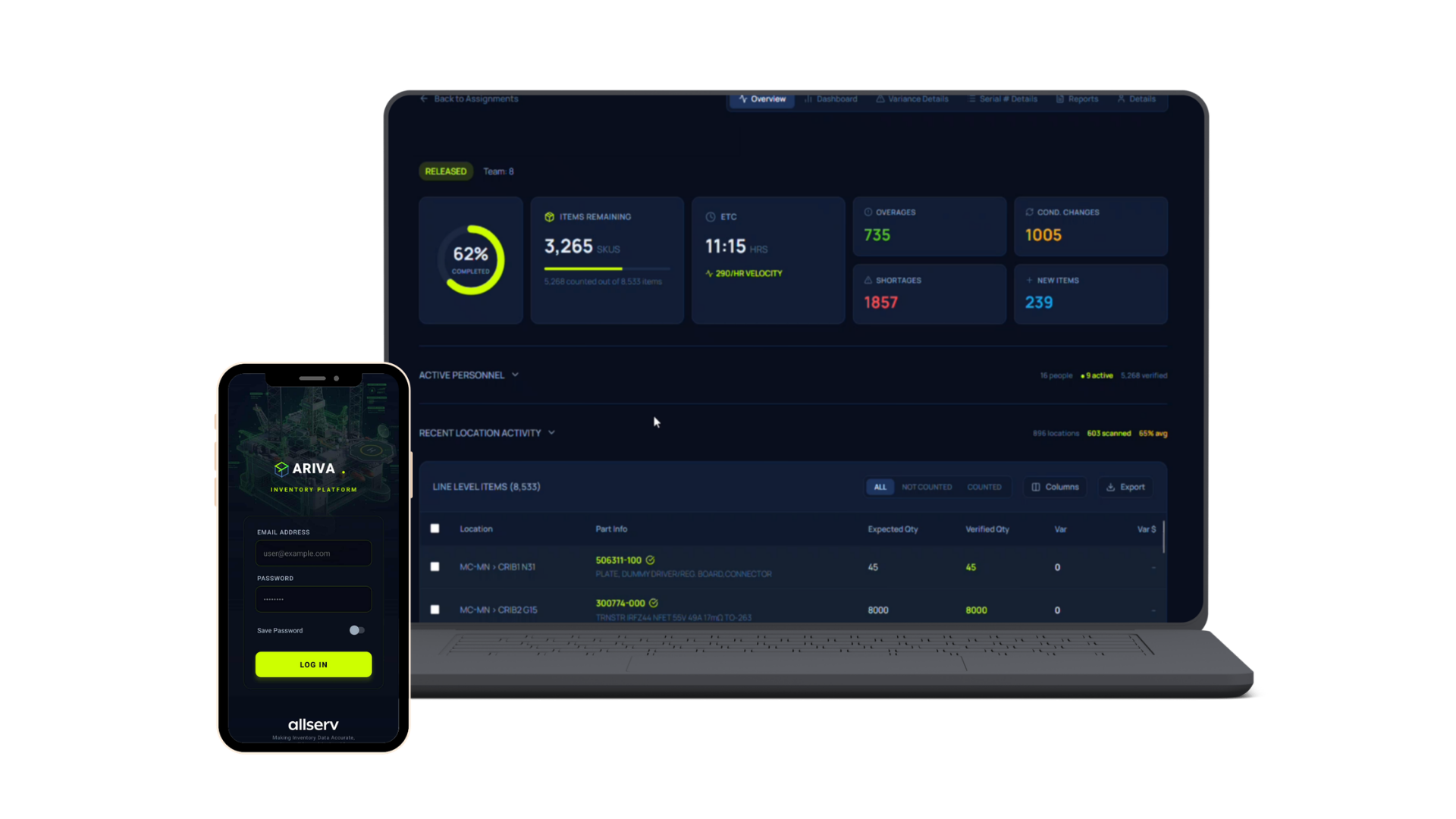
ALLSERV’s ARIVA Inventory Intelligence Suite (comprised of Catalyst and Cortex) was built specifically for the complexities of asset-intensive industries.
- Catalyst acts as the data engine, scrubbing legacy MRO data to remove duplicates and enrich attributes.
- Cortex serves as the intelligence layer, providing the supply chain analytics needed for stock replenishment optimization.
In the oil and gas sector, where data is often fragmented across multiple legacy systems due to mergers and acquisitions, ARIVA provides a system-agnostic layer of truth.
The Role of ARIVA: Industrial Intelligence for Energy
ALLSERV’s ARIVA Inventory Intelligence Suite (comprised of Catalyst and Cortex) was built specifically for the complexities of asset-intensive industries.
- Catalyst acts as the data engine, scrubbing legacy MRO data to remove duplicates and enrich attributes.
- Cortex serves as the intelligence layer, providing the supply chain analytics needed for stock replenishment optimization.
In the oil and gas sector, where data is often fragmented across multiple legacy systems due to mergers and acquisitions, ARIVA provides a system-agnostic layer of truth.


Conclusion: Securing the Future of Energy Logistics
As the energy landscape becomes more competitive, the "old way" of managing MRO is a liability. Oil and gas companies that embrace MRO inventory management as a strategic discipline will find themselves more agile, more profitable, and more resilient to market shifts.
At ALLSERV, we specialize in the "dirty work" of supply chain optimization. We go on-site, we clean the data, we optimize the layout, and we deploy the AI tools necessary to keep your operations running at peak efficiency.