
The True Cost of Poor Inventory Accuracy in Manufacturing
Executive Summary
Inventory accuracy is one of the most persistently underestimated operational risks in manufacturing. Most plant managers are aware that their inventory records have errors. What many do not fully appreciate is the compounding financial damage those errors cause across procurement, maintenance, production, and working capital. Industry research consistently shows that manufacturers operating below 95% inventory accuracy face significantly higher unplanned downtime, emergency purchasing costs, and carrying costs than those who maintain disciplined accuracy programs. This article examines the true cost of poor inventory accuracy and the operational mechanisms that drive it.
The State of Inventory Accuracy in Industrial Operations
According to APICS, world-class inventory accuracy is defined at 95% or higher at the SKU level. Yet surveys of manufacturers across discrete and process industries routinely find that average accuracy rates fall between 60% and 80%, and in MRO storerooms the numbers are often lower. A 2022 Deloitte survey of supply chain executives found that inventory data quality was cited as a top-five operational challenge by 62% of respondents.
The gap between perceived accuracy and actual accuracy is particularly dangerous. Net variance metrics, commonly reported to leadership teams, mask the true extent of inaccurate records. A facility might report a net dollar variance of 0.5% while its absolute variance, meaning the total count error without offsetting positives and negatives, exceeds 15%. These offsetting errors create a false sense of security while production schedulers, maintenance planners, and buyers make decisions based on fundamentally unreliable data.
Real-world example: During a physical inventory audit conducted by Allserv at an offshore drilling operation, the facility reported a net dollar variance of just 0.02%. When absolute variances were measured, that number rose to 2.59%. More critically, the count accuracy on critical spare parts was only 84.23%, meaning nearly one in six critical parts had an inaccurate record. The difference between net and absolute variance is not a reporting nuance. It is operationally significant.
Where the Financial Damage Accumulates
1. Unplanned Downtime
Unplanned equipment downtime is the most severe consequence of inventory inaccuracy. When a technician arrives at a work order expecting a part to be on the shelf and it is not there, the production line stops while procurement scrambles. McKinsey & Company estimates that unplanned downtime costs industrial manufacturers an average of $50,000 per hour across heavy industries, with petrochemical and automotive operations reporting figures significantly higher.
The connection to inventory accuracy is direct. If a part is recorded as available but is not physically present, no replenishment order is triggered. The storeroom shows sufficient stock. The planner schedules the job. The technician shows up and finds an empty bin. By that point, the damage has already begun.
2. Emergency Procurement Premiums
Emergency procurement is the most visible financial symptom of poor inventory accuracy. When standard replenishment fails because data is wrong, buyers must source parts urgently, often paying 15% to 40% premiums over standard pricing. Expedite fees, air freight charges, and premium supplier surcharges stack up quickly. A Gartner analysis found that companies with below-average inventory data quality spent 23% more on MRO procurement than high-accuracy peers.
Emergency buying also breaks negotiated contract pricing. When buyers step outside preferred supplier agreements to source urgently, they forfeit volume discounts and compliance savings, compounding the direct cost of the premium.
3. Duplicate and Ghost Purchasing
When buyers cannot trust what the system tells them is on hand, they often buy defensively. Duplicate purchasing occurs when parts are ordered that are already in stock at the facility or at another company location, simply because records do not reflect reality. This inflates inventory investment, consumes warehouse space, and ties up working capital unnecessarily.
Ghost inventory, parts the system says exist but do not, creates the opposite problem. Scheduled maintenance is planned around parts that are not there, labor is dispatched, and production windows are missed. The cost of a missed maintenance window, particularly in continuous process industries, routinely exceeds the cost of the part by orders of magnitude.
4. Inventory Write-Offs
Inaccurate inventory accumulates over time and eventually surfaces during physical inventory audits or system reconciliations as write-offs. According to the Manufacturing Institute, manufacturers write off an average of 1.5% to 3% of annual MRO inventory value due to obsolescence, damage, and unrecorded consumption each year. For a facility carrying $5 million in MRO inventory, that represents $75,000 to $150,000 in direct losses annually, before accounting for the labor and procurement cost of replacing consumed or obsolete stock.
5. Production Scheduling Failures
Modern manufacturing runs on tight production schedules tied to material availability. When inventory accuracy is poor, MRP and EAM systems generate incorrect material requirements, leading to either shortages that halt production or overstock situations that inflate working capital. APICS research has documented that facilities with inventory accuracy below 90% experience two to three times more production schedule disruptions than those maintaining accuracy above 95%.

Why Accuracy Degrades in Industrial Environments
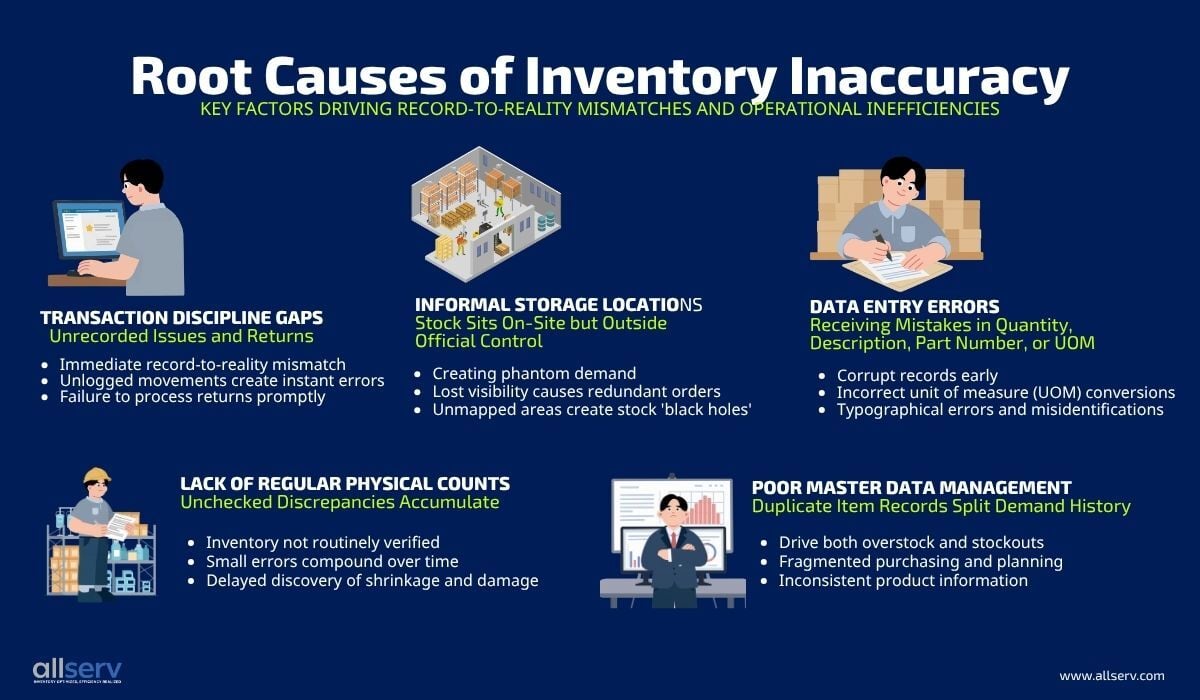
Understanding the cost of inaccuracy requires understanding why it happens. In discrete manufacturing and MRO environments, several structural factors consistently erode inventory accuracy:
- Transaction discipline gaps: When parts are issued from the storeroom without being recorded, or when returned parts are placed back on shelves without being receipted, the system record diverges from physical reality immediately. Technicians under time pressure frequently bypass formal transaction processes.
- Informal storage locations: Parts stored in maintenance shops, technician lockers, or unsanctioned locations disappear from the official inventory system while still being consumed. This creates phantom demand signals and inflates replenishment orders.
- Data entry errors: Manual receiving processes introduce description errors, unit-of-measure mismatches, and quantity discrepancies at the point of receipt. These errors compound over time.
- Lack of regular physical counts: Without periodic physical inventory audits, errors are never corrected. Facilities that rely solely on cycle counts without full physical counts tend to see errors accumulate in categories that fall outside the cycle count rotation.
- Poor master data: When multiple records exist for the same part under different part numbers, consumption is split across records and neither shows accurate usage patterns, driving both overstock and stockout conditions simultaneously.
The Accuracy Threshold That Changes Everything
The relationship between inventory accuracy and operational performance is not linear. Research published in the Journal of Operations Management found that operational performance improves gradually from 60% to 90% accuracy, but improves dramatically above 95%. At 95% and above, facilities experience materially lower emergency purchasing rates, better maintenance schedule adherence, and significantly reduced carrying costs.
The implication is clear: incremental improvement is valuable, but the goal should be achieving and sustaining 95%+ accuracy, not simply improving from a poor baseline.
The Role of Physical Inventory Audits
Cycle counts alone are insufficient for facilities with significant accuracy problems. While cycle counts maintain accuracy once it is established, they are not designed to identify and correct systemic errors. A full physical inventory count, conducted by a trained counting team using structured count methodology, provides the baseline accuracy reset that cycle count programs require to be effective.
Allserv's manufacturing inventory count services are designed specifically for industrial environments where the complexity of MRO parts, technical descriptions, and multi-location warehouses demands experienced personnel and purpose-built technology. A properly executed physical inventory audit provides not only an accuracy reset but also critical data quality insights that drive ongoing operational improvement.
Conclusion
The financial cost of poor inventory accuracy in manufacturing is not limited to write-offs and emergency freight. It cascades through procurement costs, production scheduling, maintenance effectiveness, and working capital efficiency. For most manufacturing operations, the investment required to achieve and maintain 95%+ inventory accuracy returns multiples of its cost within the first year. The starting point is an honest measurement of where accuracy actually stands, not just what the net variance numbers suggest.
Frequently Asked Questions
What is a good inventory accuracy rate for manufacturing?
Industry benchmarks, including APICS standards, define world-class inventory accuracy at 95% or higher at the SKU level. Most manufacturing operations fall between 60% and 80%, meaning there is significant financial improvement available for the majority of facilities that invest in accuracy programs.
How do you measure inventory accuracy in a manufacturing environment?
Inventory accuracy should be measured using absolute variance, not net variance. Absolute variance counts all discrepancies, positive and negative, without offsetting them. Net variance masks errors because overages and shortages cancel each other out, producing an artificially low variance number that misrepresents true operational accuracy.
How does poor inventory accuracy cause production downtime?
When parts are recorded as available but are not physically present, maintenance planners schedule work orders against those parts. Technicians arrive and find empty bins. Production stops while emergency procurement begins. The root cause is an inventory record that did not reflect physical reality, which is a direct accuracy failure.
How often should a manufacturing facility conduct a physical inventory count?
Most facilities benefit from an annual full physical inventory count combined with ongoing cycle count programs. Facilities with significant accuracy problems, active ERP implementations, or post-acquisition integration requirements may benefit from more frequent full counts. The cycle count program can maintain accuracy between full counts once a reliable baseline is established.
What is the difference between cycle counting and a physical inventory audit?
Cycle counting counts a rotating subset of inventory on an ongoing basis and is best used to maintain accuracy once it is established. A physical inventory audit counts all items simultaneously and is used to establish an accurate baseline, identify systemic errors, and support financial reporting. Both are necessary components of an effective inventory accuracy program.