


Why Manufacturing Companies Overpay for MRO Inventory
Executive Summary
Manufacturers across energy, chemicals, food and beverage, and heavy industry are systematically overpaying for maintenance, repair, and operations inventory. The root causes are structural, not simply negotiating failures. OEM part number masking, duplicate SKUs across systems, poor master data quality, guesswork-based minimum and maximum stocking levels, and reactive emergency buying behavior combine to create a persistent and largely invisible cost premium. This article examines each driver and outlines how data normalization and AI-driven inventory optimization can reverse these patterns.
The Scale of the Problem
MRO inventory is among the least scrutinized cost categories in manufacturing. Unlike direct materials, MRO spending is fragmented across thousands of low-velocity SKUs, managed by multiple departments, and often exempt from the procurement rigor applied to production materials. McKinsey & Company has documented that MRO spend in industrial manufacturing companies represents between 5% and 10% of total operating costs, yet receives a fraction of the analytical attention that direct material categories receive.
The result is predictable: significant excess cost embedded in procurement prices, stocking levels, and supplier relationships, most of it invisible until someone examines the data with sufficient depth and category expertise.
OEM Part Number Masking
How the Problem Works
Original Equipment Manufacturers routinely supply spare parts under their own part numbers rather than the original manufacturer's part numbers. A pump bearing manufactured by SKF and supplied through a major industrial OEM will often appear in the customer's inventory system under the OEM's proprietary part number with a generic description such as 'BEARING, PUMP ASSEMBLY' and a price reflecting the OEM's markup.
Without the actual manufacturer's part number and specifications, buyers cannot competitively source the item. They cannot verify equivalency with alternative suppliers. They cannot confirm that the part they are buying from a third-party distributor is functionally identical. The practical effect is that OEM dependency is enforced not by technical necessity but by data obscurity.
The Financial Impact
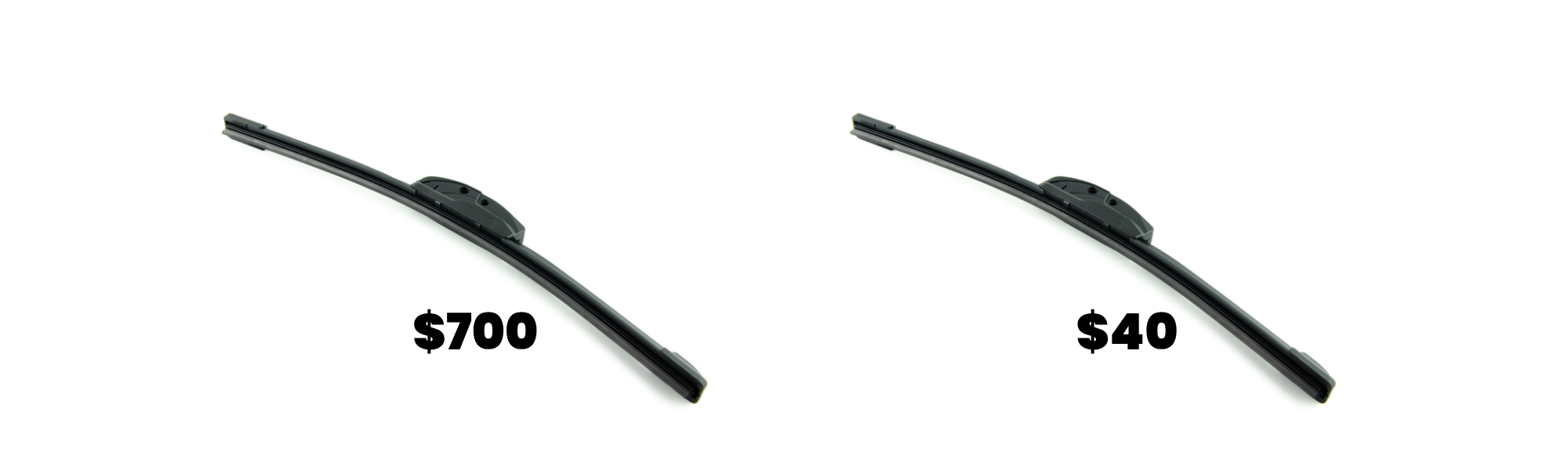
OEM markups on spare parts commonly range from 30% to several hundred percent above what the part would cost sourced directly from the original manufacturer or through competitive distribution channels. Allserv's inventory data enrichment work has documented individual cases where parts carried under OEM part numbers were available on the open market at 5% to 10% of the OEM price. A windshield wiper component found during one of ALLSERV's offshore inventory counts was priced at $700 under an OEM part number. The identical Rain-X wiper was available at retail for approximately $40.
This is not an isolated case. It is a structural feature of how industrial OEMs maintain revenue streams on installed equipment bases. The solution requires systematically identifying the true manufacturer and part number for items currently held under OEM codes, enriching the master data record with actual attributes, and creating competitive sourcing paths.
A windshield wiper component found during one of ALLSERV's offshore inventory counts was priced at $700 under an OEM part number. The identical Rain-X wiper was available at retail for approximately $40.
Duplicate SKUs and Phantom Inventory
Duplicate part records are endemic in MRO inventory systems. The same physical part may exist in the ERP system under multiple part numbers because it was received at different times under different descriptions, because different plants created their own records without checking for existing ones, or because an OEM supplied the same part under multiple model variants.
According to research summarized in Smart Inventory Solutions (2nd Ed.), the duplication of inventory records increases safety stock requirements by the square root of the number of holding points. If two records exist for the same part and each carries safety stock, the facility is holding substantially more inventory than necessary to achieve the same service level.
The management cost of duplicate records is also significant. Each SKU requires procurement administration, receiving processing, storeroom space, and periodic review. When two records exist for the same part, that administrative burden doubles while providing no operational value. Consolidating duplicates typically reduces active SKU counts by 10% to 25% in MRO inventories that have not been recently rationalized.
The duplication of inventory records increases safety stock requirements by the square root of the number of holding points. If two records exist for the same part and each carries safety stock, the facility is holding substantially more inventory than necessary to achieve the same service level. - Smart Inventory Solutions (2nd Ed.)
Poor Master Data Quality
MRO master data quality is systematically poor in industrial environments for several structural reasons. Parts data is often created at the point of requisition by maintenance technicians or storekeepers who are not data specialists and have no standardized process for attribute capture. Descriptions are inconsistent. Units of measure are misapplied. Manufacturer information is absent or recorded only at the OEM level. Cross-references to equipment BOMs are incomplete.
When buyers cannot clearly identify what a part is, they default to reordering from the last supplier at the last price. Competitive sourcing requires sufficient attribute data to verify equivalency, and most MRO catalogs do not support that kind of comparison.
ALLERV's ARIVA (ALLSERV Rapid Inventory Verification App) uses AI-assisted data collection to capture part attributes directly from parts, packaging, and technical documentation during physical inventory exercises. By capturing manufacturer name, manufacturer part number, physical specifications, and equipment linkages at the point of physical contact with the part, ARIVA builds the enriched master data record that competitive procurement requires.

Guesswork-Based Min/Max Stocking Levels
Minimum and maximum stocking levels in MRO systems are frequently set once during system implementation and rarely reviewed. Over time, equipment changes, usage patterns shift, lead times evolve, and criticality assessments become outdated. The stocking parameters, however, remain static. The result is a systematic mismatch between actual demand patterns and system-driven replenishment behavior.
The consequences of stale min/max settings are symmetrical but both are costly. When minimum levels are set too high relative to actual demand, capital is tied up in excess inventory of slow-moving parts. When minimums are too low, stockouts occur on parts that are used more frequently than the parameter reflects. Because MRO demand is inherently intermittent and variable, statistical methods rather than judgment-based guesses are required to set appropriate holding levels.
Research from Oniqua's inventory optimization work in asset-intensive industries documents that analytically optimized stocking levels reduce total MRO inventory investment by an average of 15% to 30% while improving service levels, because the reduction in excess slow-moving stock more than offsets any increases in stock for genuinely critical or high-demand items.
Emergency Buying Behavior
Emergency purchases are the most expensive MRO transactions, and they are frequently a symptom of the other problems described above. When parts are not on the shelf because minimum levels were set too low, because a ghost inventory record showed false availability, or because the part was in the system under a different part number and the buyer did not find it, the result is an emergency buy.
Emergency buying disrupts negotiated contract pricing, invites opportunistic supplier pricing, generates express freight costs, and consumes buyer time disproportionately. One reactive buy for a critical part can cost more in premiums and freight than months of planned procurement for the same item. Gartner research has found that companies with poor inventory visibility spend significantly more per unit on MRO procurement than peers with high data quality.
The cumulative cost of emergency buying also shapes organizational behavior in damaging ways. Buyers who are repeatedly in reactive mode cannot build supplier relationships, cannot conduct market analysis, and cannot negotiate effectively. The organization becomes structurally dependent on expediting rather than planning.
How AI and Data Normalization Reverse These Patterns
Addressing MRO overpayment requires a combination of enriched master data and intelligent stocking level optimization. These are related but distinct interventions.
Data Enrichment
Enriching MRO master data means capturing the true manufacturer identity and part number, standardizing descriptions to an attribute-based format, identifying and consolidating duplicate records, and linking parts to equipment BOMs. This enriched data enables competitive sourcing, meaningful spend analysis, and accurate demand signal interpretation.
AI-Driven Stocking Optimization
AI-driven inventory optimization platforms analyze historical demand patterns, lead time variability, criticality classifications, and service level requirements to set statistically valid minimum and maximum stocking levels. Unlike static min/max parameters, AI-driven settings update continuously as demand patterns change, ensuring that stocking levels reflect current operational reality rather than initial implementation estimates.
For organizations looking to move from reactive MRO management to a structured optimization program, the starting point is always accurate physical inventory data combined with enriched master data. The combination of Allserv's physical inventory and data enrichment services with AI-driven optimization creates the data foundation that sustainable cost reduction requires.
Conclusion
Manufacturing companies overpay for MRO inventory not because they lack negotiating leverage but because they lack the data quality to use that leverage effectively. OEM part number masking, duplicate SKUs, poor master data, stale stocking parameters, and emergency buying behavior are all addressable through disciplined data management and AI-assisted optimization. The organizations that invest in this foundation recover costs that have been invisible for years.
Don't let legacy data and compounding duplicates dictate your budget. Download the diagnostic today to find out which drivers are costing you and how to address the root causes.
Frequently Asked Questions
What is OEM part number masking in MRO inventory?
OEM part number masking occurs when equipment manufacturers supply spare parts under their own proprietary part numbers instead of the original manufacturer's identifiers. This prevents buyers from identifying alternative sources, forcing dependence on the OEM at premium prices.
How much do duplicate SKUs cost a manufacturing operation?
Duplicate SKU records increase safety stock requirements, inflate procurement administration costs, and consume storeroom space for redundant inventory. Facilities that rationalize duplicate records typically find SKU count reductions of 10% to 25%, with corresponding reductions in inventory investment and management cost.
How are MRO min/max levels typically set and why is that a problem?
Min/max levels are most commonly set during ERP implementation based on initial estimates or planner judgment, then left unchanged for years. As demand patterns, lead times, and equipment configurations change, these static parameters produce systematic overstock on slow movers and stockouts on genuinely active parts.
What data is needed to competitively source MRO parts?
Competitive MRO sourcing requires the true manufacturer name, the manufacturer's own part number, and sufficient technical attributes such as dimensions, ratings, and material specifications to verify equivalency with alternative suppliers. OEM part numbers and generic descriptions do not support competitive sourcing.
How does AI improve MRO inventory management?
AI-driven inventory optimization analyzes demand variability, lead times, criticality, and cost of stockout to set statistically valid stocking parameters. It also identifies duplicate records, normalizes part descriptions, and surfaces excess and obsolete inventory. The result is lower total inventory investment combined with improved parts availability.